
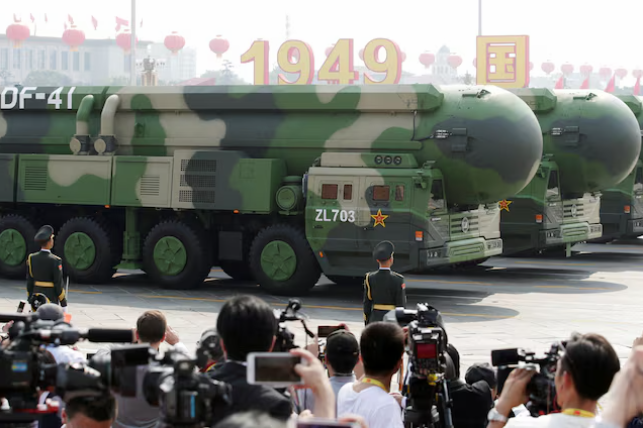
The US Department of Defense has assessed that China now has around 100 intercontinental ballistic missiles deployed in underground silos, underscoring Beijing’s rapidly expanding nuclear capabilities.
Pentagon Highlights Growing Missile Capacity
According to the assessment, China has significantly accelerated the construction and deployment of missile silos over recent years. These silos are believed to house ICBMs capable of reaching the United States and other distant targets.
The Pentagon says the expansion reflects Beijing’s effort to strengthen its nuclear deterrence and improve survivability against a potential first strike. By dispersing missiles across hardened silos, China can complicate adversaries’ defence planning.
Moreover, analysts believe the move signals China’s desire to reach strategic parity with other major nuclear powers.
Regional and Global Implications
China’s growing missile force has raised concerns across the Indo-Pacific region. US allies worry that the buildup could alter the balance of power and increase strategic competition.
At the same time, the assessment adds pressure to global arms control efforts, which currently exclude China from major nuclear agreements.
US Response and Policy Outlook
US officials continue to emphasise deterrence and dialogue. While Washington has called for greater transparency from Beijing, China has repeatedly defended its nuclear programme as defensive in nature.
US assessment of 100 Chinese ICBMs in missile silos highlights the rapid evolution of China’s nuclear forces. The development is likely to shape future defence strategies and global security discussions.


