

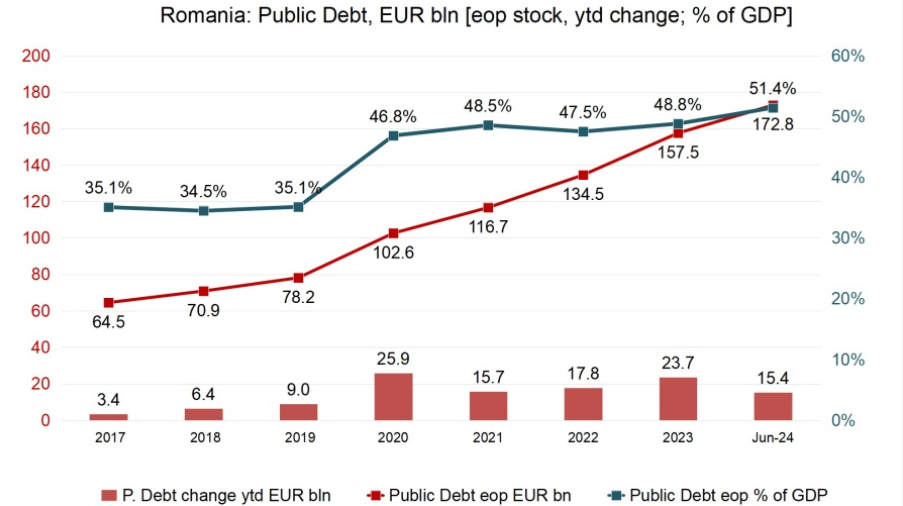
Romania’s public debt surged dramatically in July 2025, climbing by €6 billion—or RON 30.3 billion—to reach RON 1.07 trillion, equivalent to approximately 58.9 % of GDP. This acceleration follows a return to the international debt markets by the new government under Prime Minister Ilie Bolojan, which had paused foreign borrowing amid earlier political instability.
Why Romania Is Increasing Public Borrowing and Relying on Foreign Currency Debt
The jump in debt reflects both the urgent need for financing and a growing reliance on foreign-currency instruments. In July, the Finance Ministry raised USD 3.75 billion through two bond issuances (with five- and ten-year maturities) and €1.5 billion by reopening a euro-denominated bond maturing in 2039. Prior to that, Romania had already issued €4 billion in FX bonds in February and €2.75 billion in March to meet its external funding needs.
As a result of this strategy, the structure of Romania’s public debt shifted substantially: by the end of July, 54.2% of the debt was denominated in foreign currencies (euros, U.S. dollars, yen), compared with 45.8% in the Romanian leu. This represents a notable rise in currency risk, as any depreciation of the leu could make servicing foreign-currency debt significantly more expensive.
Forecasted Debt-to-GDP Ratio and Projected Fiscal Challenges
Looking ahead, analysts expect the debt-to-GDP ratio to continue rising. Based on current trends, the European Commission projects that Romania’s ratio will exceed 60% by 2026. Such a trajectory raises serious concerns about fiscal sustainability, particularly in light of the country’s large budget deficit and heavy reliance on external markets.
Indeed, Romania has grappled with escalating fiscal pressures. In 2024, its budget deficit reached a staggering 9.3% of GDP, well above the EU’s usual 3% limit. The new government has pledged corrective action, but it must balance austerity with preserving economic growth and maintaining access to international capital.
Risks and Vulnerabilities of the Rising Public Debt
There are several risks embedded in Romania’s current borrowing strategy. First, currency risk looms large: since more than half of the debt is now in foreign currencies, a weaker leu could substantially increase debt servicing costs. Second, refinancing risk is growing because a considerable share of this borrowing comes from long-term foreign bond issues. Should global interest rates rise or investor sentiment sour, refinancing could become prohibitively expensive.
Moreover, political volatility could further constrain fiscal policy. The urgency to borrow internationally may hamper the government’s ability to implement deep structural reforms. In the long run, unless growth accelerates or the budget deficit narrows, debt could crowd out critical public investments.
What Romania’s Debt Surge Means for Its Economic Future
Romania’s leap in public debt to nearly 59% of GDP by July 2025 underscores both the country’s immediate financing needs and its vulnerability to external shocks. The shift toward foreign-currency borrowing offers liquidity, but it also exposes Romania to foreign exchange risk at a time when political and economic uncertainty remains high.
Moving forward, policymakers will need to carefully manage this debt burden. Ensuring sustainable growth, reducing the budget deficit, and possibly restructuring or refinancing existing obligations may all be necessary to stabilize the debt path. Otherwise, the country could face constrained fiscal flexibility just when it needs to invest most.


 Romania Orders Local Authorities to Raise Property Taxes Before Year-End
  Romania Extends OMV Petrom Oil and Gas Licenses by 15 Years, Aims to Strengthen Energy Partnership
  Ionuț Moșteanu resigns as Romania’s Defence Minister after CV scandal
  Romania’s Prime Minister Signals Possible Elimination of Minimum Turnover Tax on Big Companies
  Romania collects EUR 100 mln in extra health insurance contributions after reforms
  Romania -born Digital raises USD 23 million for its AI platform