
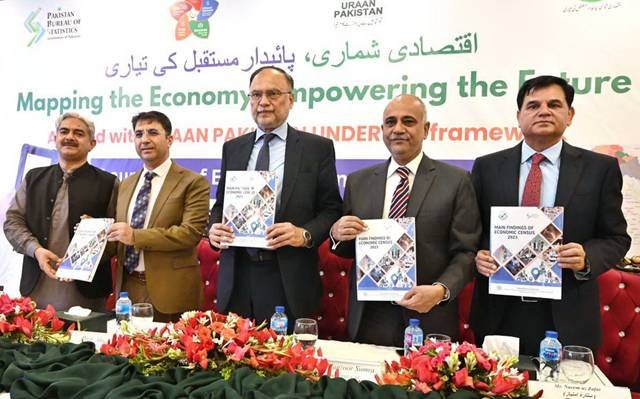
Pakistan has taken a landmark step toward modern governance by launching its first-ever Digital Economic Census. This effort marks a major milestone in how the country collects and uses economic data setting the stage for smarter decisions, fairer resource distribution, and stronger economic growth. The census results were unveiled by Planning Minister Ahsan Iqbal in Islamabad, who called the exercise a turning point for development.
A digital revolution in record-keeping empowers Pakistan’s economy
The Digital Economic Census introduces a modern twist to economic planning. For the first time, over 40 million buildings were geotagged across Pakistan. Of these, officials identified 7.2 million entities that contribute to the economy ranging from small shops to factories.
Each business received an industrial code, helping the government understand who does what and where. This technology-driven survey promises clarity on how Pakistan’s economic landscape really looks.
Beyond big factories and malls, the census shines a light on grassroots activity. It counted 2.7 million retail businesses, around 188,000 wholesale outlets, and 825,000 service shops. It also identified 23,000 factories and another 643,000 small production units.
Social infrastructure counted and documented like never before
The census didn’t stop at economic data. It also covered key social infrastructure. With complete mapping, authorities now know where 242,000 schools, 36,000 madrassas, 11,568 colleges, and 214 universities are located. They also recorded 119,000 health facilities and 600,000 places of worship. unity projects.
Planning Minister Ahsan Iqbal welcomed the census as a foundation for data-driven policymaking. He said the data will improve investment decisions, employment planning, service delivery, and governance across the country.
This scientific economic planning will help bring informal businesses into mainstream policymaking, boost women’s empowerment, and support small and medium-sized enterprises. With this new data, the country can plan more precisely and reach people who were previously invisible to planners.
Digital innovation saves money and improves transparency
Besides information, the census brought truth and transparency. Formerly, data collection relied on paper forms and manual inputs. Now, digital tools bring more accuracy with fewer errors. The Pakistan Bureau of Statistics used AI and natural language processing to clean and analyze data faster.
Pakistan stands at a crossroads. It needs to manage rapid urbanization, youth unemployment, and fragile infrastructure. Armed with real-time data on businesses, districts, and social institutions, the government can target resources effectively.


 Telegram CEO Pavel Durov vows to fight for the app amid mounting pressure from Russia
  In Our Defence Podcast: Is Bangladesh Becoming East Pakistan 2.0?
  Himanta Taunts Gogoi “He Can Contest Elections in Pakistan”
  Pakistan FM IMF Cannot Impose Conditions on National Interests
  PSX Market Surges IMF Nears Staff-Level Agreement
  Pakistan’s Struggle to Reduce Poverty