
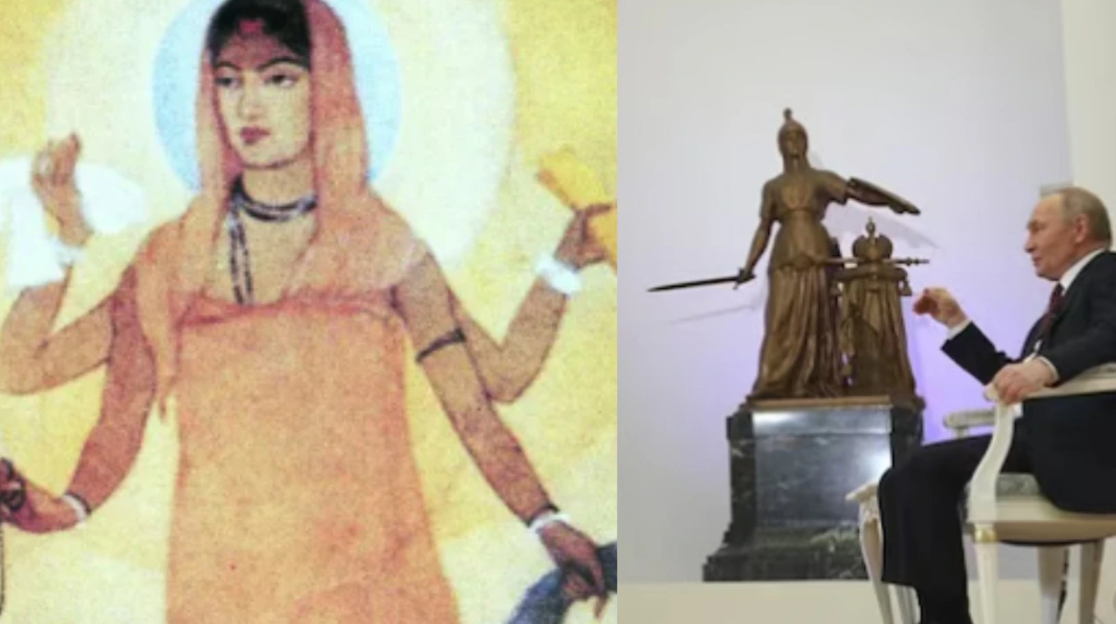
In India, the concept of Bharat Mata Mother India evokes deep cultural, spiritual and patriotic sentiment. The idea traces back to at least the late 19th century, with works like the novel Anandamath (1882) popularising the vision of India as a mother-goddess. Artistic depictions followed soon after: a landmark painting by Abanindranath Tagore in 1904 portrayed Bharat Mata with symbolic features knowledge, strength, nourishment resonating deeply with freedom-era nationalism.
But the reverence for the “motherland” is not unique to India. In Russia, an analogous symbol exists: Mother Russia. The image of Mother Russia a protective, maternal embodiment of the land — became deeply rooted in Russian identity around the early 20th century, especially through works by sculptors and artists like N. A. Laveretsky. When, in a recent interview, Russian President Vladimir Putin sat before a sculpture of Mother Russia, it was more than background decor it was a powerful visual reaffirmation of ties between people and land.
This shared symbolism a living, revered motherland forms a civilizational bridge, providing common ground beyond politics. For many Russians and Indians alike, the motherland isn’t just geography: it’s identity, duty, memory and belonging.
Cultural echoes and popular sentiment beyond diplomacy
These cultural parallels often shape popular sentiment, inform public trust, and even impact diplomatic warmth. As the article notes: when people in Moscow hear about “India,” many respond with warmth and curiosity rather than detachment. Indian culture music, yoga, festivals, cuisine resonates in everyday Russian life.
Events such as the recent “Bharat Utsav” a large-scale showcase of Indian culture held in Moscow’s Manezhnaya Square underscore this bond. The festival brought Indian dance, music, art and traditions to the heart of Russia’s capital.
Such cultural exchanges yoga days, music, art, diaspora events create micro-bridges between societies. They humanize geopolitics and make people-to-people ties more resilient, regardless of global power shifts.
Geopolitics with a civilizational backbone
While defence deals, trade agreements, and diplomatic visits draw headlines including the recent 2025 summit between India and Russia the cultural bond anchored in shared respect for “motherland” gives the partnership a deeper emotional foundation.
Analysts argue this dual foundation strategic and civilizational could help India and Russia navigate turbulent global geopolitics with a level of intimacy and trust unmatched by many other alliances.


