
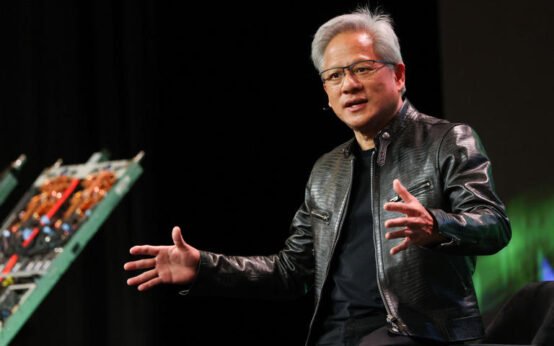
When Jensen Huang touched down in South Korea earlier this week, people expected boardroom meetings. What unfolded went far beyond spreadsheets: it had the feel of a public spectacle. His schedule included high-level talks with industry giants, but also a casual dinner that turned into a viral moment. With that, the Nvidia chief found himself at the centre of a media storm.
Starting From Tech Deal to Pop-Culture Moment
What makes this visit noteworthy is the seamless merge of serious business with cultural momentum. The chip deal underscores Nvidia’s strategic intensification in South Korea a country already strong in semiconductors, electronics and connected manufacturing. For Seoul, the partnership with Nvidia signals a push to become a regional AI hub.
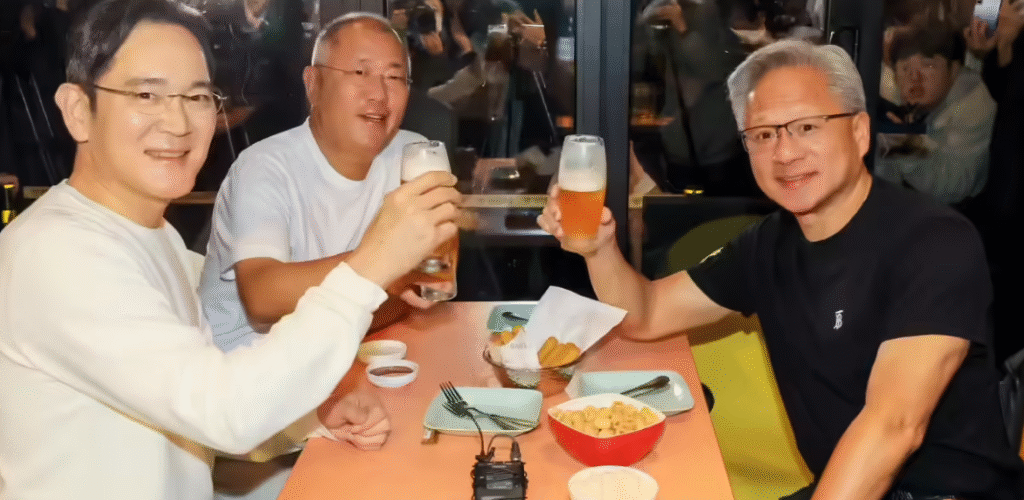
Yet the dinner speaks to something more unusual. A tech CEO in a T-shirt, blending into Seoul nightlife with two of Korea’s most high-profile executives: it changed the narrative. Analysts noted how the photos circulated on social media within hours, and even sent stock prices in related sectors soaring. The event illustrated how tech leaders have transcended boardrooms to become cultural icons.
What’s the Strategic Underpinning?
Beyond the spectacle, there are serious stakes. Nvidia’s move to supply Korea with chips comes at a time when global supply chains face rising tensions especially between the US and China over AI hardware export controls. Korea stands at a pivot point: it holds advanced manufacturing capabilities and strong global partnerships. By aligning with Nvidia, the country reinforces its position.
Nvidia, Korea is attractive: home to Samsung and Hyundai, companies already embedded deeply in semiconductors, automotive tech and electronics. Partnering early gives Nvidia a firm base outside geographies facing the most intense export constraints. The chip deal thus serves both commercial and strategic interests.
What Lies Ahead for Korea, Nvidia and the AI Race
Several questions stand out. How will Korea deploy these chips? Will smart factories, autonomous vehicles and robotics accelerate more than expected? Also, how will this pact affect regional and global tech competition—especially with China watching closely and the US-China trade tensions still unresolved?
Additionally, Jensen Huang’s public persona now matters nearly as much as his company’s tech. His visit could influence talent attraction, brand perception, investment flows and even consumer behavior in Korea and beyond.


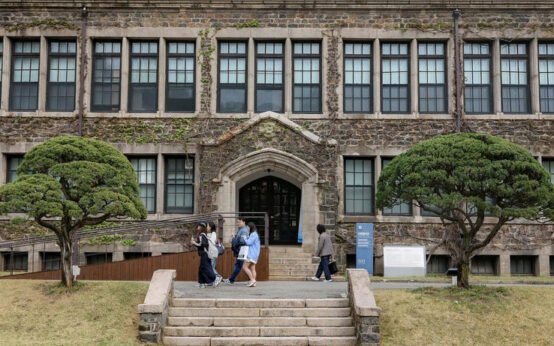 South Korea pledges $10M annually to lure elite global scientists
 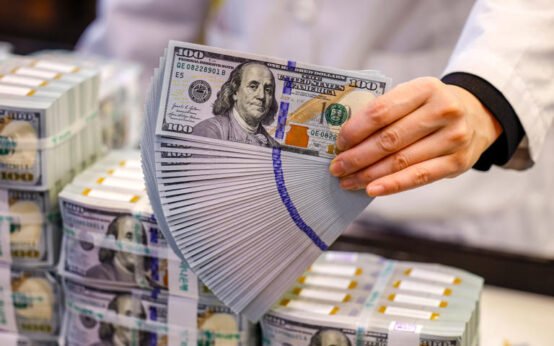 South Korea’s Foreign Exchange Reserves Hover at Low 20% of GDP Amid Vulnerability Concerns
  South Korea’s 1.9% growth trails US again
  Chinese blockade halts NVIDIA H200 component production
  NVIDIA CEO Jensen Huang Criticizes AI Doomsaying as Harmful to Industry and Society
  South Korea’s National Security Adviser Addresses US Concerns Over Revised Network Act